

Thinking Like an Economist
Learn how economists use models to understand the world.
- Economic models and why we simplify
- The circular-flow diagram
- Microeconomics vs. macroeconomics
- Positive vs. normative statements
By the End of This (LONG) Chapter
You will be able to explain how households and firms interact and tell the difference between micro and macro questions.
Step 1. Download Study Guide
Principles of Economics 101 | Study Guide for Foundational Economics
Step 2. Complete this Survey
This is required for everyone
Step 3. WATCH Whether you're a new student, or not, watch "Master Economics In 15 Minutes"
Starting with the foundations of Microeconomics and Macroeconomics before diving into the complex worlds of Econometrics, Game Theory, and Behavioral Economics, you will learn how supply and demand curves actually function, why central banks manipulate interest rates, and how mathematical models predict human behavior.
Step 4:
Economics 101 Chapter 2: Download Presentation
Download in-class presentation (Powerpoint) below
or, view: Economics 101 Chapter 2: Overview
View Presentation on the site by clicking here
Or view in-class Presentation (Powerpoint) below
4: Kahoot Quiz Review of Foundational Economics
5: Interactive Linear Production Possibilities Frontier
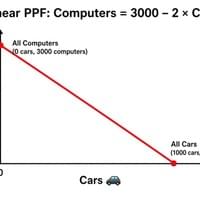
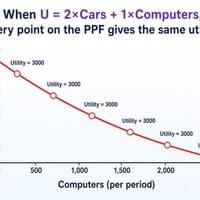
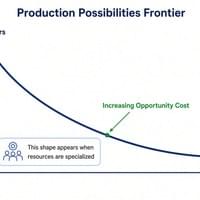
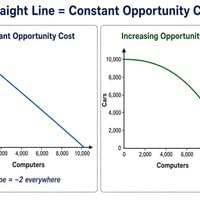
An economy can produce either Cars or Computers, and its production possibilities frontier (PPF)
6: How to Read Economic Charts
Interactive Guide
7: Linear PPF (Cars vs Computers)
Deep Dive Review
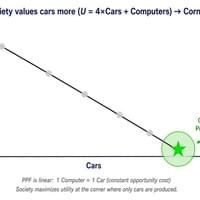
8: Review: Linear Production Possibilities Frontier (PPF)
Click here to go to the Kahoot.it, or play below
Bonus: Knowledge Check
Graphing a Demand Curve from a Demand Schedule, and How to Read a Demand Graph


